


A tensor of type  on a finite-dimensional vector space
  over a field
  is an element of the tensor
product
is an element of the tensor
product
 |
(1)
|
where  is the dual
vector space. Equivalently, using the natural pairing between
is the dual
vector space. Equivalently, using the natural pairing between  and
and  ,
such a tensor can be regarded as a multilinear map
from
,
such a tensor can be regarded as a multilinear map
from  to
to  . This definition is independent of a choice of basis.
After a basis is chosen, a tensor is represented by an array of components with  contravariant and
  covariant indices. The component transformation rules express the fact that different
arrays in different bases represent the same tensor. Thus a tensor is not merely
an array of numbers, although its components are often the most convenient way to
calculate with it. Its tensor rank in this sense is
covariant indices. The component transformation rules express the fact that different
arrays in different bases represent the same tensor. Thus a tensor is not merely
an array of numbers, although its components are often the most convenient way to
calculate with it. Its tensor rank in this sense is
 .
.
Scalars, vectors, covectors, and linear operators are tensors of types  ,
,  ,
,  ,
and
,
and  , respectively.
Tensors provide a natural and concise mathematical framework for formulating and solving problems in areas of physics such as elasticity, fluid mechanics, and general relativity.
The component notation for a tensor is similar to that of a matrix (i.e.,  ), except that a tensor
  ,
,  ,
,  , etc., may have an arbitrary number of indices.
In addition, a tensor with rank
, etc., may have an arbitrary number of indices.
In addition, a tensor with rank  may be of mixed type
  , consisting of
  so-called "contravariant" (upper) indices and
  "covariant" (lower) indices.
Note that the positions of the slots in which contravariant and covariant indices
are placed are significant so, for example,
"covariant" (lower) indices.
Note that the positions of the slots in which contravariant and covariant indices
are placed are significant so, for example,  is distinct from
  .
.
While the distinction between covariant and contravariant indices must be made for general tensors, the two are equivalent for tensors in three-dimensional Euclidean space, and such tensors are known as Cartesian tensors.
Objects that transform like zeroth-rank tensors are called scalars, those that transform like first-rank tensors are called vectors,
and those that transform like second-rank tensors are called matrices.
In tensor notation, a vector  would be written
  ,
where
,
where  , ...,
  , and matrix is a tensor of type
 , which would be written
  in tensor notation.
Tensors may be operated on by other tensors (such as metric tensors, the permutation tensor, or the
Kronecker delta) or by tensor operators (such
as the covariant derivative). The manipulation
of tensor indices to produce identities or to simplify expressions is known as index gymnastics, which includes index
lowering and index raising as special cases.
These can be achieved through multiplication by a so-called metric
tensor  ,
,
 ,
,  , etc., e.g.,
 |  |  |
(2)
|
 |  |  |
(3)
|
(Arfken 1985, p. 159).
Tensor notation can provide a very concise way of writing vector and more general identities. For example, in tensor notation, the dot product  is simply written
 |
(4)
|
where repeated indices are summed over (Einstein summation). Similarly, the cross product can be concisely written as
 |
(5)
|
where  is the permutation
tensor.
is the permutation
tensor.
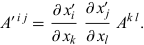
Contravariant second-rank tensors are objects which transform as
 |
(6)
|
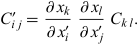
Covariant second-rank tensors are objects which transform as
 |
(7)
|
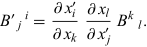
Mixed second-rank tensors are objects which transform as
 |
(8)
|
If two tensors  and
and  have the same rank and the same covariant
and contravariant indices, then they can
be added in the obvious way,
have the same rank and the same covariant
and contravariant indices, then they can
be added in the obvious way,
 |  |  |
(9)
|
 |  |  |
(10)
|
 |  |  |
(11)
|
The generalization of the dot product applied to tensors is called tensor contraction, and consists of setting two unlike indices equal to each other and then summing using the Einstein summation convention. Various types of derivatives can be taken of tensors, the most common being the comma derivative and covariant derivative.
If the components of any tensor of any tensor rank vanish in one particular coordinate system, they vanish in all coordinate systems. A transformation of the variables of a tensor changes the tensor into another whose components are linear homogeneous functions of the components of the original tensor.
A tensor space of type  can be described as a vector
space tensor product between
can be described as a vector
space tensor product between  copies of vector fields and
 copies of the dual vector fields, i.e.,
one-forms. For example,
copies of the dual vector fields, i.e.,
one-forms. For example,
 |
(12)
|
is the vector bundle of  -tensors on a manifold
  , where
  is the tangent bundle of
 and
and  is its dual. Tensors of type
  form a vector space. This
description generalized to any tensor type, and an invertible
linear map
form a vector space. This
description generalized to any tensor type, and an invertible
linear map  induces a map
  ,
where
,
where  is the dual
vector space and
is the dual
vector space and  the Jacobian, defined by
 |
(13)
|
where  is the pullback
map of a form is defined using the transpose of the Jacobian.
This definition can be extended similarly to other tensor products of
is the pullback
map of a form is defined using the transpose of the Jacobian.
This definition can be extended similarly to other tensor products of  and
and  .
When there is a change of coordinates, then tensors
transform similarly, with
.
When there is a change of coordinates, then tensors
transform similarly, with  the Jacobian of the linear transformation.
